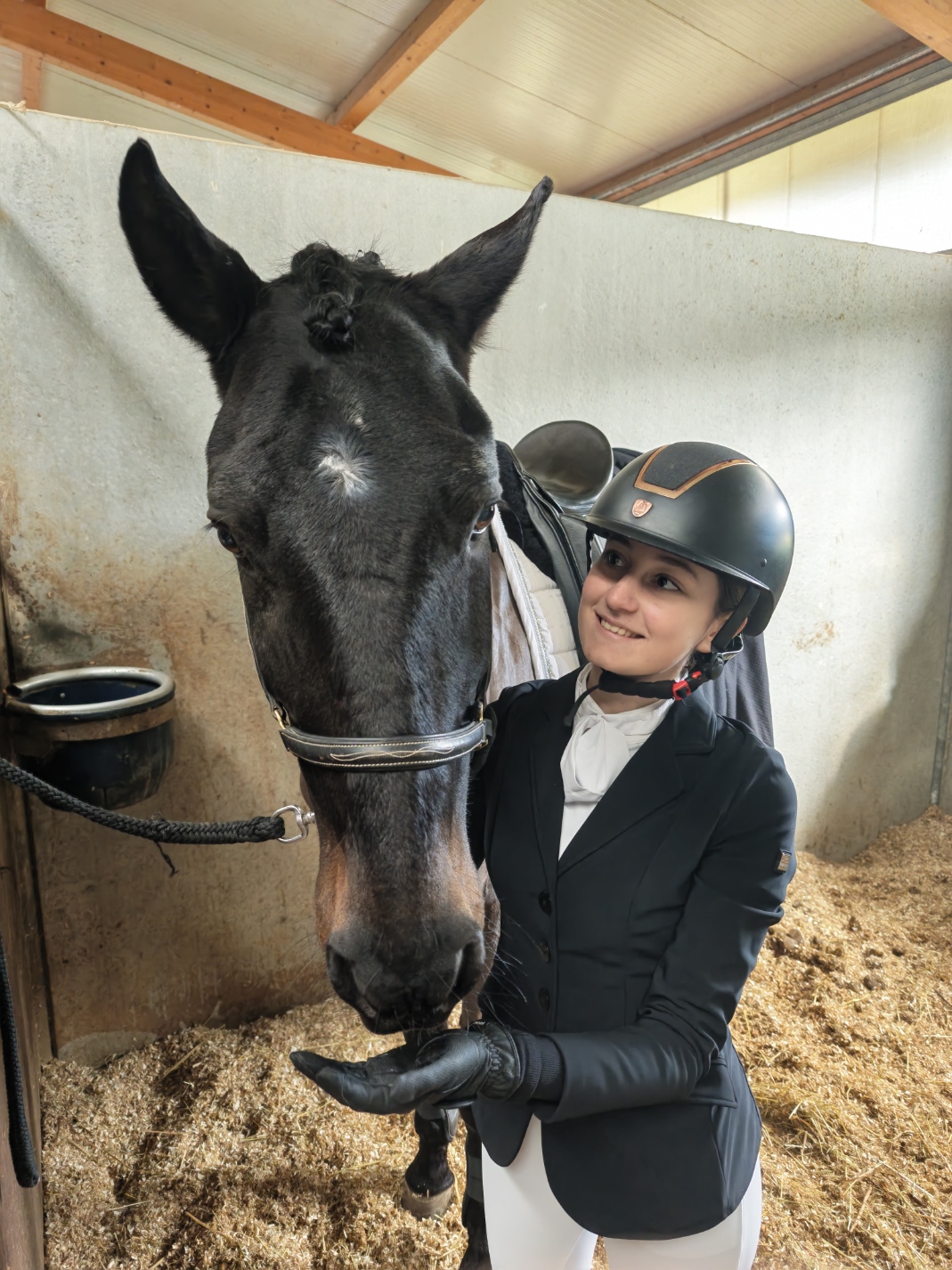
Martina Di Giura & Aramis
The horse-rider pair featured in DressAI analyses
DressAI analyzes competition tests frame by frame, extracting quantitative biometric data and providing detailed technical evaluations, animated routes and recommendations to improve the performance of the horse-rider pair.
The DressAI Engine analyzes the competition video through a four-phase process. The AI samples the most significant frames from the video (approximately 1–2 frames per second) and analyzes them with advanced computer vision models, identifying biomechanical patterns, geometries and movement dynamics.
The AI identifies key points (keypoints) on frames sampled from the video:
By overlaying these points, a biomechanical model ("The Vitruvian Man of the Horse") is created that estimates joint angles and spatial relationships between rider and horse.
Using the arena letters (A, K, E, H...) as anchor points, the AI performs a homographic transformation:
Every deviation from the ideal geometry is quantified: a circle with an 8cm radius error is excellent, beyond 1m is penalizing.
The AI measures cadence and movement dynamics over time:
Data is compared with the regulatory database of Test E100. The score is not subjective: it is based on deviation from the standard of perfection.
The AI performs a Visual Analysis of Muscular Patterns, recognizing the visible signs of tension and contracture:
This analysis allows identification of defensive contractures, areas of hypomobility and muscle tensions difficult to detect with the naked eye. The horse is not "disobedient": it is physically contracted.
The AI samples approximately 1–2 frames per second from the video. Good resolution improves the quality of the sampled frames and therefore the analysis. Extreme resolutions are not needed: good 1080p is more than sufficient.
Accepted. Complete geometric and spatial analysis. Sufficient for macroscopic errors (drifts, wrong geometries). Muscle details are less visible.
The best quality/size ratio. Good detail for visual analysis of muscle patterns, posture and geometry. Frame rate: 30fps sufficient.
Optional. Slightly improves visual detail but produces very large files. The advantage over 1080p is marginal with current AI analysis.
The numerical data presented in DressAI analyses (degrees, Newtons, percentages, centimeters) are estimates generated by artificial intelligence through visual inference. The AI recognizes the biomechanical patterns visible in the video — a contracted muscle, a shifted axis, a deformed geometry — and assigns plausible numerical values based on its vast database of biomechanical and equestrian knowledge.
These values are not instrumental measurements. To actually measure forces in Newtons, angles with sub-degree precision or contact pressures would require dedicated physical sensors (load cells, accelerometers, EMG). The value of DressAI analysis lies in the pattern identification and the overall consistency of observation, not in the precision of individual numbers.
In reports, AI estimates are indicated with the label "AI estimate" to distinguish them from direct judge observations.
The time indicated is the route completion time, calculated based on the typical speed of each gait.
Includes halts (4″ each). Does not include transitions between gaits — the actual duration in competition is longer.